Built with Managoat

13 products. One API behind all of them.

Three of them we build ourselves: a chat app, a team messenger and a shared engineering workbench. The rest were built the same way, on the same public API. Most have no backend of their own at all: static files in a browser, the API, and an agent with a real computer. That is the whole stack. All of them are open source, and all of them are running right now.

Start here

The three we build ourselves

Fountain's own UI is a console: accounts, keys, agents, environments, audit. The apps you actually work in are these, on their own origins, built on the same public API as everything below. Open one, point it at your instance, sign in.

Conversations

fountain-conversations.demo.managoat.com

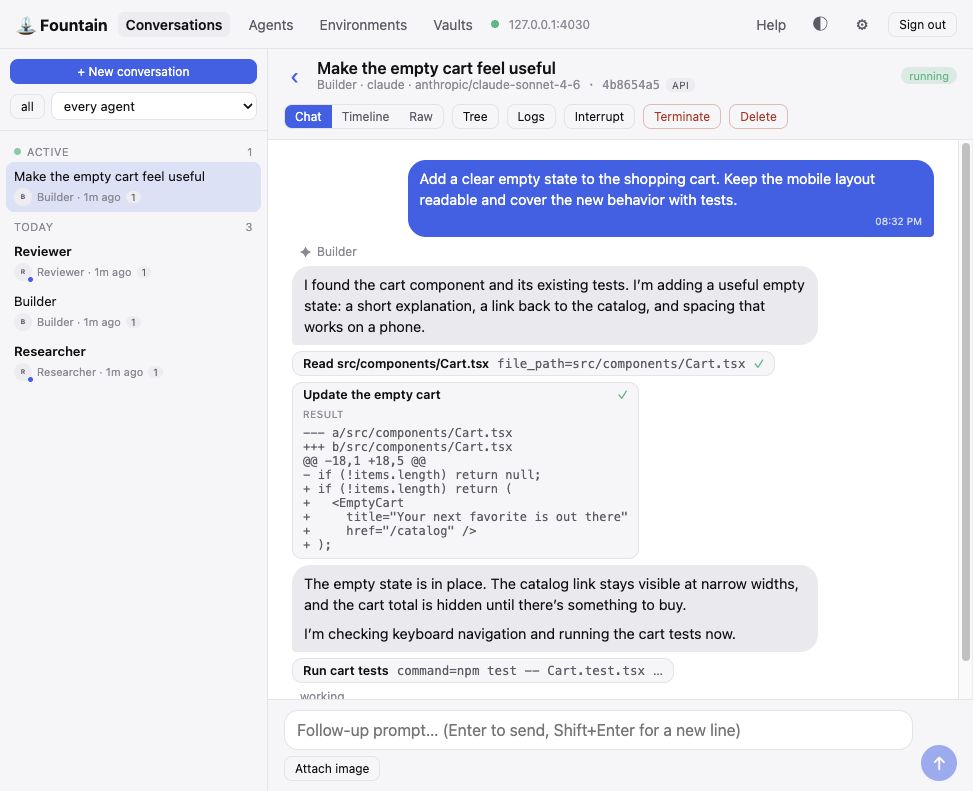
ChatGPT, except the model has a real computer and you can watch it use one.

Start a run, watch the agent work turn by turn, and drive it. Chat, timeline and raw views of the same conversation, plus the machine it shares with its siblings.

Open this one first. It is the whole platform with a face on it.

Team

fountain-team.demo.managoat.com

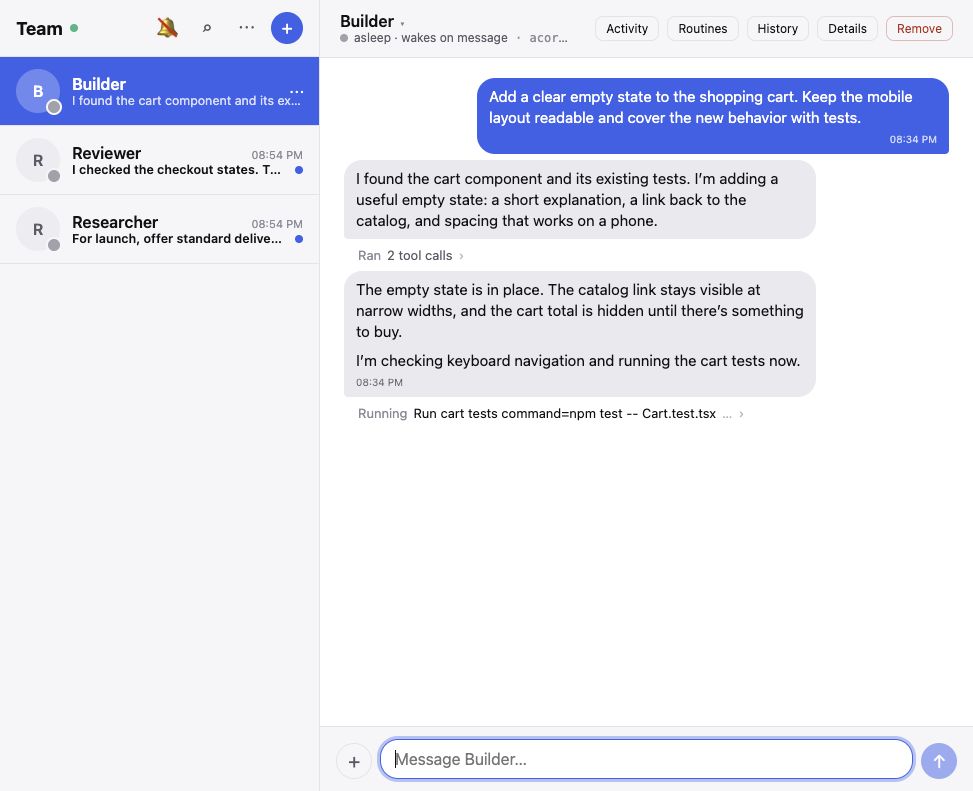
A group chat whose contacts are bots you made, one click each, faces and all.

Your agents as teammates in a messaging app. Roster on the left, thread on the right, routines on a schedule, images and search. Enter to send.

For anyone who would rather text a teammate than fill in a form.

Workbench

fountain-workbench.demo.managoat.com

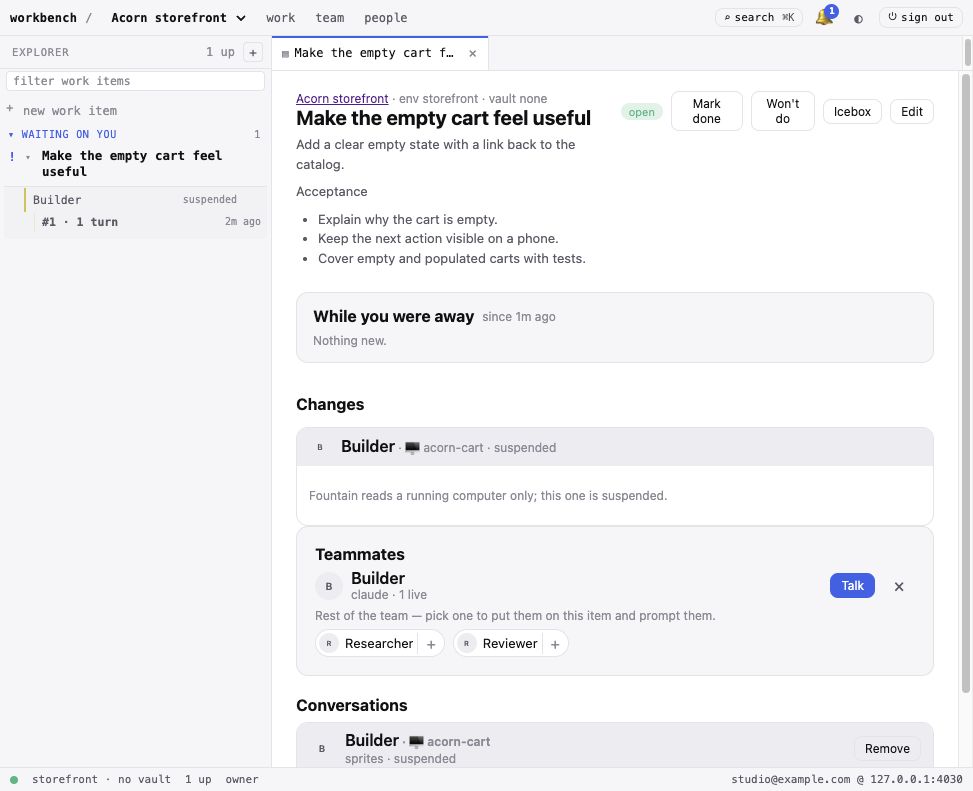
Multiplayer engineering: one board of work items, and staff you put on them by typing.

A dev workstation the team shares. A project is an environment and a vault, work items live in it, and putting a teammate on one is a first prompt rather than four steps of setup.

For a team that wants the same projects, the same agents and one place to watch.

They all connect the same way.

Open one, give it the address of a Managoat server, then sign in with your account or paste an API key. The app runs in your browser against your own agents, your own sandboxes and your own credit. Nothing of yours reaches whoever wrote it.

Step one

Point it at a server

The hosted instance, or the one you self-host. The app asks for the URL on first load.

Step two

Sign in with Managoat

OAuth with PKCE. The token it gets is an ordinary API key, so it lists and revokes under Account.

Step three

Your agents show up

Whatever the app hires runs on a sandbox on your account, and every run is a conversation you already own.

And what the API carries beyond them.

Same API, same sign-in, no backend of their own. Each one was written to prove a different thing an agent with a computer can do.

For everyone

No agent, no sandbox and no prompt box on screen. The product is the document, the chart or the text message.

Briefing Room

briefing-room.demo.managoat.com

Say what you need to understand and why. A researcher with its own computer reads real sources and hands back a clean, cited brief. A document, not a chat.

Shows web research behind a UI with none of the AI-chat furniture

Table Talk

table-talk.demo.managoat.com

Drop a CSV in. An analyst runs Python on its sandbox and comes back with charts and plain-English findings. Then keep asking questions of your data.

Shows a real computer as the engine under a zero-jargon UI

Reflex

reflex.inevitable.fyi

A personal assistant you text. It keeps a computer, your accounts and a memory, and it works while you do something else: books the dentist, sweeps the inbox at two, texts you when the tickets come back.

Shows a persistent teammate, its own phone number, and routines on a schedule

For engineers

The sandbox is the point. Each of these hands an agent a checkout, a shell and a task list, then shows you the work.

Repo Sage

repo-sage.demo.managoat.com

Name any public GitHub repository. An agent clones it on its own machine and answers with file-and-line citations that link back to the source.

Shows the sandbox as a workstation: clone, grep, read, cite

Mission Control

mission-control.demo.managoat.com

Describe a mission. A coordinator plans it, you approve the plan, and the app starts one sandboxed agent per task. Watch the fleet work and take one report.

Shows plan, approve, fan out, multiplex the streams, synthesize

DNS Desk

dns-desk.demo.managoat.com

A DNS operator for your Cloudflare zones. Ask in plain words, read the plan as a diff, approve. The zone tables stay on screen while the agent does the work.

Shows plan, approve, apply on a live system, with a vault as the blast radius

For infrastructure

Nobody is watching these. A schedule wakes the agent, it decides whether anything needs doing, and most of the time the answer is no.

Watchtower

watchtower.demo.managoat.com

An SRE teammate on a cron: uptime, latency, TLS expiry and DNS for every site you name. When a tile turns red, ask it to investigate. It has real tools.

Shows schedules as a product heartbeat, the conversation as the store

Mend

mend.demo.managoat.com

What an audit finds across a repository's CI, manifests, Dockerfiles and cloud templates, and what an agent does once you hand it that tool. Mechanical fixes applied, judgement calls argued, one patch back.

Shows a real CLI in the sandbox, and the restraint to leave the ambiguous ones alone

Rounds

rounds.demo.managoat.com

Dependabot for infrastructure config. Enrol a repository and it gets audited on a schedule; an agent fixes what it can verify and opens the pull request. Never twice for the same finding, never again for one you closed.

Shows an unattended product, and an agent that knows when to do nothing

For AI engineers

Several agents at once, side by side, with the numbers underneath.

Arena

arena.demo.managoat.com

One prompt, several brains, side by side. Blind columns, live streams, latency and token counts, and your vote on the scoreboard.

Shows parallel conversations, the model catalog, per-turn usage

Build the next one.

A static page, the TypeScript SDK and Sign in with Managoat is the whole recipe. The manual walks a team chat end to end, and the apps above are the working copies to read.

Each app is MIT licensed and hosted by its author, not by Managoat. Signing in hands it a key scoped to your account, which you can revoke at any time under Account and API keys.